In
Chapters 4 and 5 of McChesney’s Digital
Disconnect, he discusses the rise of capitalism in the internet in the late
1900’s. As McChesney and a number of other authors point out, when the internet
became available to the public it was supposed to revolutionize the way that
people think about well... everything. It was supposed to crush corporations,
make information available to everyone, destroy corruption, increase happiness and
it was supposed to be the epitome of equality as a utopia separate from
reality.
Internet capitalism
according to McChesney, began when corporations began to patrol the internet,
its users who used their services for a small monthly fee. Users were able to
browse the web freely in their “walled garden” areas of course (103). This
alone was a huge shift from the egalitarian idea that existed before the rise
of capitalism. When businesses stuck their big greedy feet into the endless
stream known as the internet in 1990, ideas like equal access for all, and
sharing for the common good became obsolete. McChesney believes that equality
was destroyed when the patent explosion occurred. Of course, with the large
number of people in the market, some people naturally wanted to turn a profit
instead of allowing others to access their information for free. According to
Berners-Lee, patents became a “very serious problem” and they sparked the
creation of monopolies. Instead of becoming a utopia, it was becoming a
“technological dream or legal nightmare” (104).
Businesses, of course,
knew that what they were doing was going against the original vision of the
internet but they “were not about to disappear quietly for the good of humanity”
(105). They were more focused on making a profit. The internet was supposed to
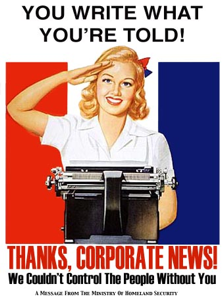
be like this but it ended up like this The first problem and most important problem that I have with the idea that the
internet was to become a community of “sharing for the common good” is that not
everyone is going to be willing to share. In order for something like communal
sharing to work, the majority must agree on a decision and stick with it. Once
one person begins to gain footing over others, the idea of equality is
completely thrown off.
The 1996
Telecommunications Act led to deregulation which was actually a goal of the
internet but it ended up backfiring because with all the changes happening to
internet (controlled subscription garden utopias) there needed to be gov’t regulation
to help out the little man. Cooperation between businesses led to the creation
of conglomerates. Influential businesses putting forth their ideas of internet
services for profit and backing each other up “legitimizes the commercialization
of the internet” (109). When plenty of big corporations come together and make
it seem like what they’re doing is “right” or natural, few can oppose them.
There
was always a lot of talk in the past about what the internet was supposed to do
for people but not much about how people could use the internet to make these
things happen. In the first section, McChesney says that, “The Internet was
expected to provide more competitive, markets, accountable businesses, open
governments, an end to corruption, etc…It has been a disappointment” (McChesney
97). How can one be disappointed in something that is unable to act on its own?
The internet has no agency. Corporations and monopolies ultimately controlled
the path that the internet took in the late 1990’s. Would it have been possible for an egalitarian community to be created using the internet as a medium if things had not happened the way they did? or is internet equality for unattainable simply because a select few (companies/people) will always “rise to
the top and dominate web?”

The question that you pose about the inevitability of the course that the internet took is an interesting one. While I believe that the internet was a disappointment in some ways, as McChesney emphasizes, I do not think that its success is dependent on an egalitarian community. The roots of access inequality extend deeper than the corporate decision-making. Regardless of the relevance of media conglomerates, I think that inequality was in the natural trajectory of a medium like the internet. History has shown that the tendency of new technologies, with few exceptions, is to fall into the hands of a few successful organizations. For example, Wikipedia dominates Google searches despite the fact that it is void of a profit motive. I do realize that corporations play a significant role in access; McChesney discusses the point that it is not profitable for communication conglomerates to extend coverage to rural areas, for example. However, the egalitarian sentiments would have to extend far beyond internet policy to create a truly equal medium.
ReplyDeleteThanks for the reply Rachel. I like your statement about the inevitable inequality of the internet. Its interesting to think about this idea. Whenever new technologies emerge, they have a trickle down effect. Those in power, or those with the money to afford the technologies get to experience them first while those without the means to acquire the technologies get them last or not at all. In my Intro to Media class, we had a reading that discussed the electrical grid and how its really the only neutral/ equal "system" out there. Although, even the electrical grid was only originally available at first to those who could afford it before it was made available in public spaces.
ReplyDelete