Wednesday, February 26, 2014

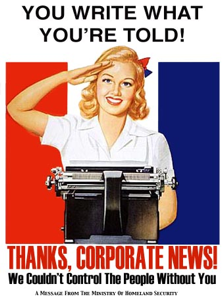
Journalism is indeed dying, group C

In Chapter 6 of Digital Disconnect by Robert W. McChensey, he brings a lot of issues up about the journalism of today that I think need to be addressed. In general, that fact that the New York Times is called the “the worst newspaper in the world-except for all others” speaks to the decline in newspapers since the beginning of the digital age. The chapter talks about the heavy layoffs in the industry as well as the decrease in frequency of publishing the news.
One of the more concerning things in the chapter was about what the loss of journalism means. McChensey gives the example of the explosion in West Virginia that killed 29 coal miners. The Washington Post and New York Times did exposes after the mine exploded and found that the mine had over a thousand safety violations. The problem with this is that the records were available giving this information before the event happened which means that “we are entering an era of ’hindsight’ in journalism.” (181) That’s a huge problem that journalism doesn't prevent problems by making them public anymore but rather they report the issues after they happen.
As a future Public Relations employee I shouldn't have a problem with the fact that the Pew Center “found official press releases often appear(ing) word for word” in news stories.  But I do, because that means that journalism isn't being done as much as it was in the past.   Right now the ratio between PR people and journalists are 4:1. Public relations professionals are supposed to persuade and journalists are supposed to be objective. You can’t just get rid of journalism and replace it with press releases from public relations professionals.  It changes what news is all together.
However, I think his most interesting point was about the Wiki Leaks situation in relation to satisfactory journalism. McChesney writes that to some that Wiki Leaks released an immense amount of secret US documents between 2009 and 2011 is an example of investigative journalism at its best and a demonstration of the power of the Internet as an informational source. However, it was only after journalists wrote about the releasing of the documents that it came to the public’s attention.  Journalism was needed to give the material credit and to analyze what it meant.  McChensey made his opinion known about the scandal with the strong words he uses on page 196. He writes that the US journalism stood by meekly when the government took steps to render Wiki Leaks ineffective and that “all the signs suggest that Wiki Leaks, rather than being the harbinger of a new era, may have been the last gasp of an old one.” (196)

All of this to me is depressing. What has happened to journalism? What parts of the loss of journalism struck you? Do you agree with McChesney about Wiki Leaks? 

Sunday, February 23, 2014

Conquering the Internet- Nora Kornfeld, Group B

    One of the concepts in Chapter 4 and 5 that I found most interesting is McChesney's idea that capitalism conquered the Internet. He wrote that for the first two decades of its existence, the Internet was "singularly noncommercial, even anti-commercial" (97). However with more and more large corporations, monopolistic markets, advertising, public relations and close relationships with the government and the military, the Internet transformed into a capitalistic force.
    One of the key ways in which McChesney believes capitalism conquered the Internet is through advertising. Advertising became so important to digital corporation giants because they wanted a way to bring money in in order to compete in their market. Advertising, especially online advertising, continues to be a key way in which large corporations continue to bring in money. Corporations have taken note of how much time we spend on the Internet, and have used that to their advantage. McChesney writes that in the 1990s no one complained much about a "lack of advertising on the Internet, or a shortage of advertising anywhere else for that matter,"( 146) but today, most people view ads negatively. Today, it is even hard to think of a time when the Internet was commercial free. The development of cookies and other technologies transformed Internet advertising. With cookies and online tracking, advertisers were able to track users tastes and advertise specifically to their needs and interests. Advertisers have also used personal information users post on social media sites like Facebook and Twitter in order to reach consumers on a more personal and specific level.  I see these cookies and tracking techniques in action everyday on my Facebook page. Every time I search something or shop online, there is an ad from that company or store almost immediately.
    Recently though, online advertising has been vulnerable to hackers. In an attempt to stop hackers from interfering with online advertising, Google has purchased the fraud detection company Spider. Google wants to make online advertising safer and more profitable for advertisers. Google’s goal is to make advertising with the site more reliable, which will increase the cost of placing ads on Google.
    Overall, McChesney's capitalistic Internet will continue to be dominated by a few key players. Large corporations like Google are doing whatever it takes in order to dominate their market. Google makes profits off of advertising, so purchasing Spider will help increase ads on Google thus increasing revenues. The 1990's Internet McChesney described seems like a different world. I am really curious to see how the Internet continues to develop in this technological world.

Accuracy over timeliness? Group B

            Chapters 4 and 5 brought up several interesting points about Wikipedia, Net neutrality, and journalism.  There are a lot of questions I wanted to ask the class so be aware for the discussion below! 
            I first want to start off with the idea of Wikipedia.  Page 108 states that, “Wikipedia ranks near the top of most Google searches- that ‘it’s unlikely any reference source would unseat Wikipedia.’”  Wikipedia is either highly praised or talked down upon.  I personally like using Wikipedia because I find it a reliable source.  However, I do realize that random people can just edit the information on it very easily which is not promising at all.  Even though many of us are aware of this I still use it.  Do any of you agree?
            On page 113 I read that other countries had higher cell phone service prices.  Were you guys surprised to read that cell phone service was cheaper in other countries?  I feel the United States jacks up all their prices.  I compare the United States to being the New York City of the country.  For instance, when a person goes to the McDonald’s in Times Square the price for a McDouble is so much higher than the price for one in Collegeville.  It’s crazy but I think it’s because it’s a centralized location.  I see the United States as being a powerful hub for other countries to look up to. 
It was also interesting to read about healthcare and that “Americans pay far more capita than any other nation but get worse service” on page 116.  It’s disappointing because people need health care and we evidently don’t seem to be getting sufficient attention and we pay more. 
I never realized the comparison with internet and healthcare.  It’s all about giving attention to the strongest links.  Both are worried about the weakest links such as “unhealthy customers or people from ‘risky’ demographic groups” or “customers in poor or rural areas, where the firms find either revenues are too low or costs are too high.”  They are worried about the baggage and only care about the profit.  What do you guys think of this? Do you think the richer should get richer or should help the poor?
We learned about Net neutrality is Media and Society last semester and how everyone should have equal access to the internet.  It’s also mentioned on page 118 how “in the 1990s many Americans assumed the Internet was a magical platform that let everyone have an equal right to speak, thanks to technology.”  Do you agree with this stance or do you believe only certain people should have access to the Internet?
An important topic that I enjoy discussing is censorship on the Internet.  I believe that censoring things is important in terms of young children surfing the internet and finding things they should not be looking at.  However, I think this is the parent’s job to monitor this.  I don’t think the government should step in to censor something because it is taking away from what is available on the internet.  It should be a person’s personal choice to view something.  I want to elaborate on censorship with a link because I think it’s important to know both sides of the debate of censorship.  This reminds me of Communism because governments in certain countries regulate what their citizens can see.  For example, a Communist government will not let citizens read something on the Internet that would degrade their country.  I personally think it’s not being very truthful when there is censorship.  How do you guys feel about this?

It reminds me of journalism and how accuracy is the number one priority.  A journalist should never sacrifice accuracy just to appease the public.  A journalist’s job is to be the watchdog for the public.  For instance, if something unprofessional or controversial is going on, the journalist must do his or her duty of reporting to the public and informing them of what is going on.  My professor always told me that sources will get angry but it is not your duty to please them.  Of course a journalist should be respectful and ethical though.  I love discussing this topic of journalism and really want to know what the class thinks about accuracy in the news.  

"Skip ad here"- Group B

            “When the internet emerged, the notion that it would be a distinctly noncommercial space was uncontroversial and widely embraced” (McChesney, 146). I wish. Nowadays, getting on the internet seems like advertisements with a side of web content. No matter how much we hate it, online advertising is probably one of the most intelligent moves made by marketers. Today, advertisements online are unavoidable. Marketing firms made it so that there is no retreat from the world of advertisements anymore.
            Within the past two year, I started noticing something that, at first, freaked me out a little. I got on Facebook and started to notice that the advertisements on the right side of my screen were closely related to web pages I had recently visited. How in the world did Mark pull this one off? Cookies, that’s how. “Websites could then “quietly determine the number of separate individuals entering various parts of their domains and clicking on other ads” (McChesney, 147). If this is possible now, to what extent will we put this to a halt? This seems like internet stalking to me. Soon, gadgets that are stashed away in a purse or a briefcase might even be able to detect what stores you go to and places that you visit all on their own. It is kind of scary to think about the potential of the internet’s intelligence, but its progression is undeniable and unstoppable.
            Advertising agencies depend on the internet to be one of their most loyal clients. However, with the advancement of online advertisements, problems arise. Michal Wronski explains. With the lack of space on the internet, advertisements begin to lose their quality. This undermines agencies, and overall, it underestimates the field of advertising. This is being solved with the use of more video advertisements and animations, but, as a frequent internet user, this is what I try to avoid the most. The advertisements that take away from my personal internet time are those that infuriate me.

            Online advertising will never stop. Most likely it will keep advancing. Online advertisements can be one simple click away to landing a deal on a pair of shoes you have been wanting, or they can set you back three minutes through a video advertisement before a YouTube video. I know they are here for good, but all I know is that I hope that goes for the “skip ad” button also.

Digital Rockefellers

As we know from Chapter 4 of McChesney's "Digital Disconnect," the world was "uniformly optimistic" about the potential of the Internet before coming to fruition. People hoped it would create a democratization of communication; a place where there would be access to a "treasure trove of uncensored knowledge." But even more so, people thought that it would prevent corporations from snaking in customers and crushing all of their competitors in search of a monopolistic and powerful endgame.

It is unfortunate to be alive today and realize that none of these aspirations, now lofty in retrospect, ever came into being the truth. When reading chapters 4 and 5, what really caught my attention was the idea of these big companies which emerged upon the conception of the Internet to became the monopolizers of the entire medium. The exact opposite occurred in comparison to what people had hoped the Internet's future would hold.

I particularly enjoyed the section in which McChesney lists the household names of the companies that dominate the digital age because I had never thought about just how much power these companies hold: Apple's iTunes dominating 87% of digital music downloads; Amazon selling 70-80% of all physical and digital books; Google--holding 70 percent of the search engine market (which McChesney notes is approaching the monopolistic status that Rockefeller's Standard Oil had at it's peak."

And then there is Facebook. The book quotes Mark Zuckerberg as saying that Facebook "was not originally created to be a company... it was built to accomplish a social mission--to make the world more open and connected." Unfortunately, though, somewhere along the line commercial success took the foreground of Facebook's mission to which they now neglect.

Here is a link to all of the companies that Facebook has eaten up in it's effort to dominate the social realm of the internet. Some big ones that many of you will probably recognize are Instagram and, recently, WhatsApp. It is interesting how all of these companies were birthed with good intentions to provide a service to all Internet users. But, eventually, they decide that it is not good enough to be successful at providing a good service--it's better to dominate at providing a service.

Saturday, February 22, 2014

Keon J. Group B: Is the Internet a big Disappointment?

           In Chapters 4 and 5 of McChesney’s Digital Disconnect, he discusses the rise of capitalism in the internet in the late 1900’s. As McChesney and a number of other authors point out, when the internet became available to the public it was supposed to revolutionize the way that people think about well... everything. It was supposed to crush corporations, make information available to everyone, destroy corruption, increase happiness and it was supposed to be the epitome of equality as a utopia separate from reality.
Internet capitalism according to McChesney, began when corporations began to patrol the internet, its users who used their services for a small monthly fee. Users were able to browse the web freely in their “walled garden” areas of course (103). This alone was a huge shift from the egalitarian idea that existed before the rise of capitalism. When businesses stuck their big greedy feet into the endless stream known as the internet in 1990, ideas like equal access for all, and sharing for the common good became obsolete. McChesney believes that equality was destroyed when the patent explosion occurred. Of course, with the large number of people in the market, some people naturally wanted to turn a profit instead of allowing others to access their information for free. According to Berners-Lee, patents became a “very serious problem” and they sparked the creation of monopolies. Instead of becoming a utopia, it was becoming a “technological dream or legal nightmare” (104).
Businesses, of course, knew that what they were doing was going against the original vision of the internet but they “were not about to disappear quietly for the good of humanity” (105). They were more focused on making a profit. The internet was supposed to be like this but it ended up like this The first problem and most important problem that I have with the idea that the internet was to become a community of “sharing for the common good” is that not everyone is going to be willing to share. In order for something like communal sharing to work, the majority must agree on a decision and stick with it. Once one person begins to gain footing over others, the idea of equality is completely thrown off.
The 1996 Telecommunications Act led to deregulation which was actually a goal of the internet but it ended up backfiring because with all the changes happening to internet (controlled subscription garden utopias) there needed to be gov’t regulation to help out the little man. Cooperation between businesses led to the creation of conglomerates. Influential businesses putting forth their ideas of internet services for profit and backing each other up “legitimizes the commercialization of the internet” (109). When plenty of big corporations come together and make it seem like what they’re doing is “right” or natural, few can oppose them.

            There was always a lot of talk in the past about what the internet was supposed to do for people but not much about how people could use the internet to make these things happen. In the first section, McChesney says that, “The Internet was expected to provide more competitive, markets, accountable businesses, open governments, an end to corruption, etc…It has been a disappointment” (McChesney 97). How can one be disappointed in something that is unable to act on its own? The internet has no agency. Corporations and monopolies ultimately controlled the path that the internet took in the late 1990’s. Would it have been possible for an egalitarian community to be created using the internet as a medium if things had not happened the way they did? or is internet equality for unattainable simply because a select few (companies/people) will always “rise to the top and dominate web?”

Thursday, February 20, 2014

"If you ain't first yer last"-Is competition nescesary?

America! Land of the free and home of the brave. Free to vote, free to pursue happiness, and free to use the internet. America is a champion of capitalism, we love the free market and politicians are willing to go to extreme ends to preserve it.  One of the aspects of capitalism is the encouragement of competition. In theory, companies will compete against each other which benefits both the consumer and the supplier. The consumer benefits from low priced goods that are high quality, while the producer benefits from increased sales and profits. In many circles, capitalism seems like the only way an economy should operate and the government has no right interfering. However, in our capitalistic society it seems as though competition in the internet industry is at a minimum.

The media industry is heavily conglomerated, meaning the few companies own the majority in some way.  When the mid-90s policy makers decided to deregulate the media industry, it lead for those companies to become even more powerful. In Digitial Disconect, it is reported that all but 4% of American households has at most 2 choices for internet providers and some only have 1 choice  This lack of diversity is shown through price differences across nations. Cellphone service in Sweden is vastly cheaper and higher quality than it is in America. Also, there is speculation that these companies are working together to meet each-others needs and create less competition and higher prices. With prices high, an uneven access to the internet is kept in tact. Only those with resource can afford to have it in their homes and all the wonderful Utopian expectations of the internet are lost.

So is it time for government intervention? Timothy Karr of the Huffington Post thinks it is necessary. In his article he calls for action, seeing the internet as a public good that should not be privatized or controlled by any one company. He sees it as unfair that these companies seem to 'control' the internet and almost have a monopoly over it. Thus, Americans are paying more for less and are being cheated.  Though, Is this conglomeration just a result of successful companies being successful? Many people think that powerful corporations benefit society because the success of the company trickles down to providing more jobs and better wages. However, has this success of few companies gone too far? It is very hard for upstart providers even to compete with the corporate giants, creating no hope for market diversity. Personally, I would love to see some more competition because I do not want to pay high fees to use the internet if I do not have to, but with the way things are it does not seem like this is happening anytime soon.

The topic of media conglomeration is one that is highly complicated because no one simply knows what is absolutely best for the nation as a whole. One can poke holes in either side of the argument. Competition and conglomeration have benefits but also have their negative side effects. Should the government intervene to create more competition in the internet market or should the situation be left as it is and let the top companies continue to have control?

Tuesday, February 18, 2014

RIP Newspapers- Group A

Upon reading McChesney's piece I found one thing to really stick out. That is the concept of Newspapers taking the backseat to the Internet. Not only has the internet altered the way the news is reported it has altered the use of newspapers as well as the way the conglomerate news sources have shifted their reporting. For the most part, we can address news as progressing from the internet because we have the ability to receive "breaking news" through alerts and receive quick excerpts of situations moments after the situation. The question that arises for me is, does reporting the news faster really count as progression or does it only open the gate for inaccurate information? Has the internet pushed the newspaper back so far that it is a "dead" source?

When I think of the news, I think of dissecting what is true and what is false and then actually interpreting the news reported. I feel that the internet has caused us to be very precautionary because the quickest information isn't always the most accurate. In this article, you get a great insight as to how the news on the internet (in this case social media) can be both good and bad. The first thing you will notice is the picture that a 49 year old marathon runner "reported" and eventually became a vital piece of evidence in capturing the boston marathon suspects. If you read further you can see that that is not always the case. One suspect, who was a student and indian-american, had his picture uploaded to social media as "a suspect" and in reality he had no ties to the bombing. Within no time his photo spread across the internet until it was debunked. In this particular case, information with no validity became wide-spread simply because it was reported so fast. In just a touch of a button, this kids face can be "retweeted" to the world.

Something else I thought of was, why would we ever use a newspaper again? Ironically, when I looked for another link to share with you guys I stumbled across a website called "Newspaper Death Watch", so that's that. But in all seriousness, I believe the internet has given little meaning to the news. No longer is tomorrow's paper the "breaking news" and no longer is it efficient to look for job postings and no longer are cartoons shoved in front of kids. We can get all of these things so fast and so easily, the newspaper is pretty much "old news". From my experience, every time I pick up a newspaper I only use it to verify what I already know.

I wonder if you guys have similar thoughts. Do you use a newspaper? Why do you use it? Does it really serve a purpose anymore? Should we choose the internet or the newspaper? Can we trust the internet?

Let me know how you guys feel.

Advertising Nothing - Group A


In Chapter 3 of Digital Disconnect, McChesney explores the idea of the entertainment industry and how advertisements make up a substantial amount of the profits. Being a film minor, I am very interested in cinema, so I was very excited to read about American films and the impact advertisement has on them.

McChesney explains how the film industry looks to produce projects that can be made into “prequels, sequels, spin-offs, adaptation to other media, toys, video games, merchandising, and licensing income” (McChesney, 75). However, this was not always the case.

Tim Wu compared films from the 1960s to films during the 2000s. By taking the top ten most expensive films during the 60s and 00s, he found that the latter films were produced based off of other potential revenue streams. This means that films were made based off of whether or not an action figure could be made replicating the movie’s star.

Films during the 60s were mostly standalone movies. This time period is seen as a very successful time for American cinema, not financially, but artistically. But as time went on, movies made in the 2000s, seemed to show less of a concern for the actual film quality, and stressed more of an importance on ‘how can we make this as profitable as possible?’ This is where sequels, prequels, and merchandise all became of great importance.

This makes me upset. Even though I am really into movies, you don’t have to be a huge fan to know that this is not right. The exploitation of film is deteriorating the quality. I am not saying that all movies that are huge sensations, like Harry Potter, are bad movies, or of worse quality. However, I am mad that films are being made just to open up other opportunities of revenue. I even discussed this in my film class today. We spoke about how 3-D has transformed the film industry. Now 3-D is being thrown into films, just to inflate the ticket prices. Movies that do not use 3-D for artistic purposes, but rather to increase profits, is a perfect example of the, ‘other revenue streams.’

This concerns me because this happens in so many other fields, not just cinema. McChesney writes, “Advertising is of particular importance because it has provided much of the revenue that has supported entertainment media for the past eighty years.” Advertising is so powerful because it can take many forms. Just looking at cinema, if a movie were being advertised it can be through toys, or video games, or clothes. Looking at Harry Potter again, there are toys, video games, clothes, sequels, and now even its own theme park, just to increase the hype and advertise the movie. Every time I see a shirt with Harry Potter on it, I am a victim of advertisement.

According to the Washington Post, advertisements are tricking people into buying more of a product than they need. Brad Plumer writes "ads do seem to persuade people to buy more than they otherwise would." 

This is why I say victim, because advertising is very powerful and has a control over society. McChesney writes “advertising’s otherwise questionable contribution to society…It can strongly influence the nature of media content, mostly for the worse” (75). Clearly, McChesney believes that advertising does not benefit society. I would definitely agree with this. Do you think that advertisements are benefiting society? Look at advertisements as a whole, or you can look at them on a more specific level, like examining the film industry’s relationship with advertisements. I see them as detrimental, not only to films, but to all fields. Do you agree with McChesney and me? Or are there other benefits, aside from monetary gain, that I am not seeing?

What Has Happened to Journalism? Group A

   In chapter three of Robert McChesney’s Digital Disconnect, the author brings up how recent parts of media have been changed because of the Internet, such as advertising based on what the audience wants and how copyright laws have changed the media. He also discusses how journalism has been changed, and I found that to be the most interesting part of this reading. McChesney writes about how “...the distinction between news media and entertainment media has been blurred, if not obliterated” (82). I found this to be the most thought provoking part of the journalism section, and I was able to think of certain examples from recent years that support McChesney’s claim about the problem with the state of journalism.
    Upon reading that quote, I immediately thought of how our culture has become obsessed with high profile trials. I thought of two of the more recent trials like Casey Anthony and Jodi Arias. For those who don’t know, Casey Anthony was believed to have murdered her baby daughter, and Jodi Arias was believed to have viciously murdered her boyfriend. We watch the live feeds of the courtroom every day in both of these cases, we wait for verdicts to be revealed, and we wait to see what these high profile defendants do next. These high profile, very serious cases should be regarded as news, but we become so obsessed with them that we actually see them as entertainment. We would rather discuss Casey Anthony joining a reality show than discuss the logistics that caused the jury to find her not guilty of murdering her young daughter. That CNN article can be found under their entertainment section rather than their justice section where it probably should be.
    I thought I could find an article discussing how the Casey Anthony trial was regarded more as entertainment rather than news, but while searching through the Google results, I came across a Wikipedia article describing what this type of news is. This type of journalism is called Sensationalism. The article states, “Sensationalism is a type of editorial bias in mass media in which events and topics in news stories and pieces are over-hyped to increase viewership or readership numbers.” Along with the Casey Anthony trial, Wikipedia uses the Bill Clinton/Monica Lewinsky sex scandal and the O.J. Simpson trial. The article also states that certain journalists or shows have been known to report incorrect facts when reporting these trials just to gain viewership. However, this can be very effective. Nancy Grace, for example, has been criticized in the past for misreporting information on high profile cases on her show. That didn’t stop her show from attracting the most viewers ever for the HLN channel when the Casey Anthony verdict was read. Her show reached five million viewers as that article states.
    Bringing it back to McChesney’s text, the cause of the lack of distinction between news and entertainment news is commercial pressure, like commercials on the radio, television, and/or Internet. McChesney says this has been happening since the early 1980s, and “it has led to a softening of standards such that stories about sex scandals and celebrities have become more legitimate because they make commercial sense: they are inexpensive to cover, they attract audiences, and they give the illusion of controversy without ever threatening anyone in power” (91).
    Do you guys agree with McChesney that commercial pressures on new technologies, like the Internet, have caused this decrease in journalism? Do you think that trials like Casey Anthony, Jodi Arias, and O.J. Simpson are seen as entertainment rather than serious news stories?

How Beneficial is Technology and the Internet? - Blog Group A


               In chapters one through three of the Digital Disconnect by Robert McChesney, there was a lot of information regarding how the internet and technology has changed the world. I found the sections about the Celebrants and the Skeptics extremely interesting.  They allowed the reader to see both sides of this enormous entity that has taken over our world.
                Now, the question is do you side with the celebrants or the skeptics about how beneficial technology and specifically the internet have been for society? Most people would quickly respond by saying that technology has transformed our world for the better, but I am a little hesitant when looking at the global picture. I completely agree that my life is so much better with technology and the internet in it; yet, there are many people and countries that do not have the same opinion.
                By 2020 there will be 22 billion devices around the world connected to the internet (p 2). That is truly astonishing that people around the world will be able to connect so easily. Information will be spread quicker, communication will be easier, and so many more amazing things, but the way information is spread today I cannot see how we will be more informed with more people able to access the internet. For example, the United States and Europe are both very well connected to the internet and relatively curious as to what is happening with each other. However, there are so many enormous things that we as Americans are not exposed to. For instance the former Prime Minister of Italy, Silvio Berlusconi, was and still is a media tycoon in Italy where he owns roughly 75% of all media outlets. For the past 20 years he has been running the country to his liking to make him more money and give himself more power. He does this through his control over the media. Here is a great profile of Berlusconi detailing all of his media involvement, scandals, jail sentences, illegal activity, and much more.  McChesney states, “technology is as capable of being destructive as it is progressive” (p 10). This idea is crucial to the understanding of how powerful technology and the internet is, because depending on who has the control, it can get taken advantage of, and this is exactly what Silvio Berlusconi did.
                This idea of too much power is what the PEC tries to manage. Like the book says, “It evaluates media and communication systems by determining how they affect political and social power in society and whether they are, on balance, forces for or against democracy and successful self-government” (p64). This is definitely a great thing to have a check and balance system attached to technology, media, and the internet because without it, things could get out of control. That is why when asked if I think technology and the internet was beneficial I do agree that it is, but I hesitate because I think the only way it can be good is with some watching over and possibly restraint.
                Another interesting point of these chapters was how they discussed that social media cites have actually led to an increased amount of loneliness (p11). This is extremely interesting because I think most people would agree that Facebook seems to be used, especially nowadays, to make your life look amazing and that you have all of these friends and do all of these amazing and interesting things, but in reality most of the time you are at home looking at another person's glorified pictures on their Facebook. Thus, not everything is as great as it appears. Overall, I am truly amazed at what technology and the internet were able to accomplish, but I do think it is interesting how large the gap is between the internet being truly beneficial and still problematic.

Monday, February 17, 2014

Is progress for the best? Group A


McChesney’s discussion of critical junctures prompted me to consider the implications of the mass technological changes that, according to Digital Disconnect, humanity has undergone four times in its history. It is clear that shifts in available technologies and their uses have an impact on the way we live. A primary component of the author’s argument addresses how these changes interact with political economy, or more specifically, the political economy of communication. What particularly interested me were the changes that occur on this level during these critical junctures and how they might influence not only the way we exist, but how we think. McChesney suggests that technology is “not only revolutionizing society, but changing the nature of human beings” (70). As evolving technology impacts our political environment and even our biology, I think that it is important to consider the opportunity that critical junctures present to mold the human condition: for better, for worse, or in a neutral way.  
Cultural and social artifacts are inevitably lost and gained during periods of critical juncture. McChesney offers examples from each period of critical juncture to evidence the ways that technology can render obsolete practices that were once considered inherently human. One such example is the shift from oral to written cultures. Citing Claude Levi-Strauss, the author proposes that “the immediate consequence of the emergence of writing was the enslavement of vast numbers of people” (71). This distinctly negative, politicized connotation suggests that these shifts can detract from the overall quality of the human existence. In addition to altering the social and political structure of society, I was thinking about the ways that technology influences the way we operate in other unintended ways. In his article “Is Google Making Us Stupid?” Nicholas Carr argues that technology, specifically the Internet, is having negative consequences on the ways that we think. He suggests that the Internet is impairing our ability to do everything from focus for prolonged periods of time to reading critically. The trends in human behavior that Carr attributes to the rise of the Internet correlate with the fourth (potential) critical juncture: the digital age. Carr emphasizes the negative attributes of the digital age, but I think that it is hard to argue that the Internet has solely detracted from the human condition.  
The changes to our ways of thinking that result from critical junctures can also be perceived as beneficial. Referring again to the critical juncture of the digital revolution in which we are situated, some theorists have argued that the Internet has had a positive effect on the way that we process information. As McChesney points out, the transformation from oral to written culture ushered in an era where memory was less important and complexity was valued. Similarly, a study  entitled “Does Google Make Us Stupid?” conducted by the Pew Research Center in response to Carr’s article offers the perspective that the Internet may be impacting us in positive ways. A component of the study required scholars and other people well-established in this field to respond to open-ended questions about the impact of the Internet. Many of them, such as the Paul Jones of the University of North Carolina, suggest that the Internet, specifically Google, allows us to “be more creative in our approaching problems and more integrative in our thinking.”
Essentially, no one can say for sure whether the cultural, social and intellectual shifts that occur during periods of critical juncture have positive or negative effects on us as humans or the political economy to which we contribute. I believe that the effects of technology have, thus far, had enough positive and negative effects that its trajectory cannot be characterized by one or the other exclusively. As we move further into the digital age, I think that the Internet and other new media have altered the ways we think. While we may have a more difficult time reading on an in-depth level as Carr suggests, we are now able to gather unparalleled amounts of information very quickly. We are spending less time gathering information and more time analyzing it, but at the cost of our ability to research critically. The critical junctures that mark the chronology of technology have a significant impact on the way we live and the medium through which we engage with political economy, but I believe the quality of these changes cannot be precisely defined. What do you think?